By Samara Murray and Allegra Fuerderer
EDMONTON, Alta — In the dead of winter, when Edmonton is bitter cold, the Flying Canoë Volant is a warm light of celebration; four days full of laughter, dancing, live performances, storytelling, and culture.
La Cité Francophone and the Native Counselling Services of Alberta united for the 14th year with the Flying Canoë Volant from January 28th to 31st. The festival was created to celebrate Métis, Indigenous, and French-Canadian cultures and takes place in the Mill Creek Ravine and the neighbouring blocks of 86th Avenue and 91st Street.
Approximately 100,000 people will have attended the festival by the end of the four days, making the event a “connector not just for [Indigenous, French-Canadian, and Métis] cultures but for all peoples who are here in Edmonton, and beyond,” says festival director Allen Jacobson.
A walk through the ravine to the Trapper’s Cabin is where you’ll find Roger Dallaire, the storyteller of the Flying Canoë Volant for over 10 years.
He opens his performance with a harmonica and accordion jam before getting into the legend of the Flying Canoe.
The French-Canadian legend La Chasse-galerie gives the festival its name and was born from an Indigenous story of a flying canoe and a French tale of a man condemned to the skies.
A popular version tells of lumberjacks who make a deal with the devil to fly them home in a canoe. The catch? They must steer clear of churches and not say the name of God on their journey, or else they give their souls to the devil. No spoilers on the end of the story here, but you can read the full tale, as retold by Honoré Beaugrand in 1848, at this link: https://beq.ebooksgratuits.com/english/Beaugrand-tales.pdf
Dallaire performs in French and English, uniting people through music and legends. “In Edmonton,” he says, “There’s a festival where we celebrate our entity; French, Métis, Indigenous, all mixed together. It’s a beautiful mix.”
Indigenous music, performances, bannock, and reconciliation services are programmed by Native Counselling Services of Alberta. They are an “integral part of the program,” says Allen Jacobson. Lead lantern artist Dylan Toymaker reflects on his creative collaboration with Métis, Indigenous, and French-Canadian artists, as he is not of any of those cultures himself: “That’s something I enjoy a lot.”
Zetta Anderson, a Métis attendee, says, “Being Métis is something very complex because we feel isolated sometimes from First Nations and non Indigenous communities. So it’s super nice to see a place where your culture is celebrated.”
“We honour the cultures that were here before us, and we honour the present, and especially we try to develop for the future, ” says Jacobson.
The festival, at its core, is about community and bringing warmth in the midst of cold weather. “My favourite part… being out with friends,” says five-time attendee Dominique Beaudoin.
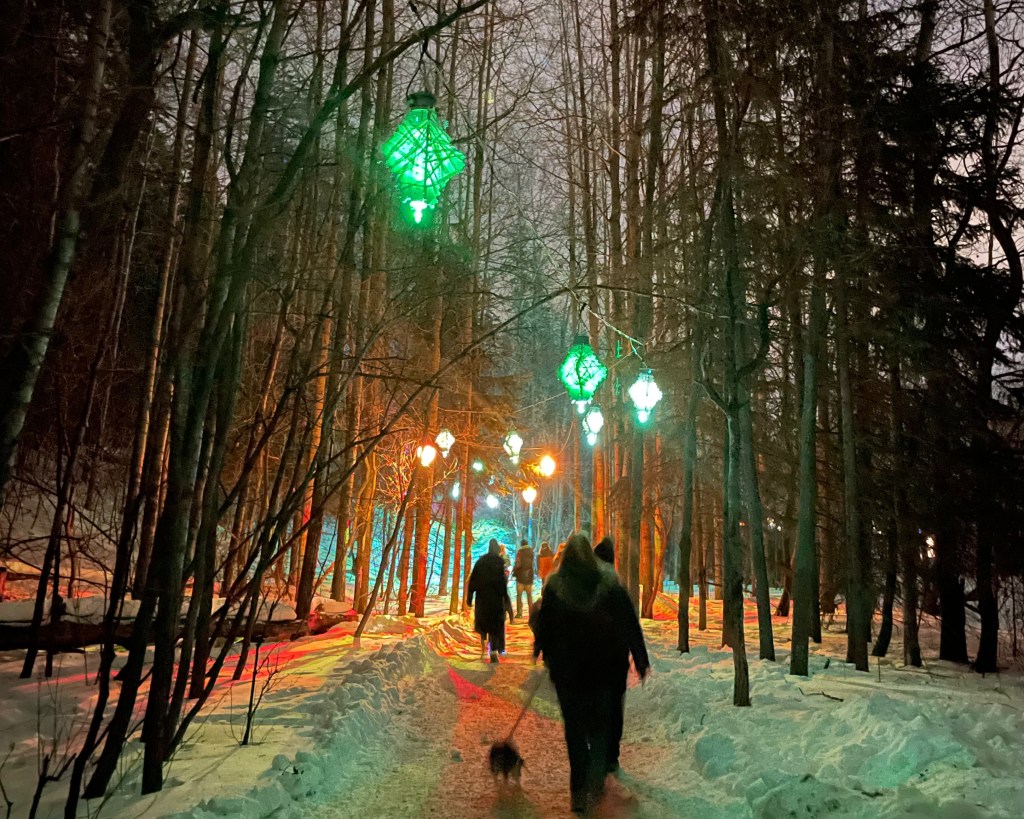
Dylan Toymaker’s art is the guiding path through the ravine.
Through 14 years of work, Toymaker’s relationship with the surrounding nature has become personal. “[The trees] don’t talk to me in my sleep,” he jokes. He said that working in this environment has absolutely “been a major part of shaping how [his] work exists in this world.”
The lanterns are beautiful, their light poking through the pitch-black ravine like stars in the sky. “It’s all really pretty… Makes a really nice atmosphere,” says attendee Rebecca Wiebe. “The winter feels a little bit less cold.”
 Samara Murray Tries to Write
Leave a comment